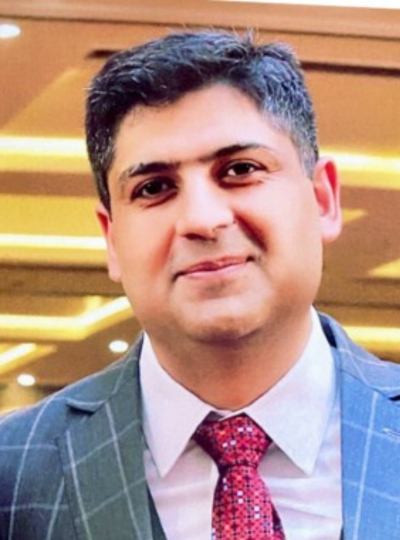
Economist by training. Entrepreneur by calling.
Building businesses that endure.
My grandfather migrated from Pakistan during Partition with almost nothing. In 1957, he started Ahuja Dairy Products — built on purity, trust, and long-term relationships. My father took a different path and built Ahuja Steels into a respected industrial trading business. Growing up between these two worlds gave me a lens that no classroom could.
I studied Economics at Hansraj College and IIM Bangalore, but the real education came from watching businesses survive, adapt, and endure across generations. I noticed early that classical economic models miss what actually drives Indian markets: informal networks, trust capital, execution intensity, and the weight of relationships built over decades.
I started my career in the steel business, learning trade, margins, and operations from the ground up. Then I built Digitopper, a SaaS platform that digitizes and distributes educational content at scale. Today, roughly one in three private CBSE schools in India uses a Digitopper-powered product. Our work on books like RD Sharma has brought over half a million students into structured digital mathematics learning.
In parallel, I am reviving Shahji Ghee as a fully integrated D2C brand and transforming Ahuja Steels into a technology-enabled B2B marketplace with its own manufacturing capabilities.
The pattern I observed across generations: each built something valuable but did not fully carry forward what came before. I see my role as changing that, by unifying these businesses into a cohesive group that combines legacy strengths with modern technology and disciplined scale.
I also teach, mentor, invest in early-stage startups, and write. I believe knowledge compounds when shared. This is not just about building businesses. It is about continuity, relevance, and building something that genuinely endures.
"Capital can be raised. Technology can be copied. Policy changes. The one thing that cannot be manufactured at speed, in India or anywhere, is trust. That is what I build around."
Heritage businesses carry something no startup can buy and no marketing budget can manufacture: trust that has compounded over generations. The opportunity is not to disrupt that. It is to build modern operations, distribution, and technology around it, while keeping the original promise intact. That is the framework I have applied at Shahji Ghee, and I believe it is replicable across thousands of Indian family businesses.
Formal economics describes the skeleton of a market. In India, the muscle, the nervous system, and the circulation are almost entirely informal. Relationship networks, trust-based credit, community distribution, and unwritten contracts move more value every day than any model accounts for. Understanding these invisible rails is not a cultural observation. It is the most important analytical skill for anyone building or investing in Indian markets.
In India, most startups do not fail at scale. They fail before they ever get there. The first mile, finding genuine product-market fit in a market that is cost-sensitive, deeply relationship-driven, and where trust precedes transaction, is a problem that no Silicon Valley playbook was written to solve. Building for India at the 0-to-1 stage requires a fundamentally different mental model, not a localised version of someone else's.
India's growth narrative is almost entirely written around consumption. The less told story is supply. Across sectors, supply chains in India are fragmented, relationship-dependent, and resistant to standardisation. That is not just an operational problem. It is a structural economic inefficiency that suppresses margins, limits quality consistency, and keeps markets artificially local. Technology, applied thoughtfully to supply chain architecture, is the highest-leverage economic intervention available in India today.
In any market where quality cannot be observed before purchase, the economics shift in a predictable direction. Competition is no longer purely about who makes the better product. It is about who communicates quality most credibly. Brand, certification, provenance, and consistency of experience become the primary instruments of value capture. Understanding this dynamic changes how you think about pricing, positioning, and where to invest in a business.
Metro India and Bharat are not points on the same spectrum. They are distinct economic environments. Purchase decisions in tier-2 and tier-3 markets are shaped by different income structures, stronger community influence, deeper relationship dependency in commerce, and a fundamentally different relationship with price and value. The businesses that will define the next decade of Indian growth are not those that scaled their metro playbook downward. They are those that started by understanding Bharat on its own terms.
Most business builders go deep in one industry. Technology, dairy, and steel sit at very different ends of the business spectrum, yet the same economic forces shape all three. Operating across them simultaneously forces a different kind of thinking. Patterns that are invisible inside one sector become obvious when you can see them repeat across three. Running all of them has taught me more about how markets actually work than any single industry ever could.
Digitopper is the technology layer behind some of India's most widely used educational content. We build SaaS infrastructure that helps the country's largest publishers digitize, manage, and distribute content at scale across the CBSE ecosystem. Our platform powers e-books, test generators, content engagement tools, and school-facing digital products. Through our publisher partnerships, roughly one in three private CBSE schools in India uses a Digitopper-powered product. Our digitization and engagement work on titles like RD Sharma Mathematics has brought over half a million students into structured digital mathematics learning, making it one of the most accessed mathematics learning platforms in the K-12 segment.
Partners include India's top educational publishers. Reach spans 10M+ students and teachers.
Shahji Ghee is a heritage A2 desi ghee brand with roots going back to 1957. What began as a trusted local dairy business has been rebuilt into a fully integrated, technology-enabled D2C company. We control the entire value chain from in-house milk sourcing and manufacturing to retail stores, e-commerce, and direct consumer delivery. Stores currently operate in Delhi and Meerut, with a structured pan-India expansion in progress. Shahji Ghee is not a nostalgia project. It is a deliberate attempt to prove that a legacy brand, when rebuilt with operational discipline and the right technology, can compete and win in the modern premium FMCG market.
A living case study in legacy brand revival, technology integration, and premium FMCG building.
Ahuja Steels has operated in India's steel supply chain since 1982, earning its standing not through scale alone but through four decades of consistent execution, deep buyer-seller relationships, and a reputation that holds across market cycles. The business spans trading, distribution, and rolling mill manufacturing of long products, with a steel pipe manufacturing unit currently being commissioned as part of a move toward a fuller product stack. In parallel, we are building DialSteel, a B2B marketplace that digitizes steel commerce with integrated discovery, pricing, and logistics. Steel in India remains one of the most fragmented and opacity-driven markets in the country. DialSteel is our attempt to change that from the inside, backed by four decades of supply chain depth and market credibility that no new entrant can replicate.
Transforming a traditional industrial business through supply chain digitization.
Active investor in early-stage EdTech and F&B startups. I help founders navigate the critical first mile — product-market fit, unit economics, go-to-market strategy, and the India-specific playbook most global frameworks miss.
Every business I run today carries lessons from businesses that did not survive. I have always believed that a founder who only talks about their successes is either lucky, dishonest, or has not taken enough risk. These three ventures failed. Each one cost me money, time, and confidence. Each one taught me something that no success could have.
Ahuja Sportz Pvt. Ltd.
Fresh out of college, I launched a T-shirt brand built around a simple idea: music, sports, and entertainment are immortal, and that feeling deserved a brand. I designed for the college crowd, got the product right, and even managed to place stock with leadings retailers across North India. Then working capital killed it. Retailers ran long credit cycles. Money did not come back fast enough to fund the next production run. After six months and real losses, I shut it down.
Topper Learning Solutions Pvt. Ltd.
I started a NEET preparation coaching centre in Meerut at a time when the test prep market was growing fast. The subject was right, the city was right, and the timing felt right. What I underestimated was the difficulty of student acquisition in a market driven entirely by word of mouth, teacher reputation, and peer validation. Without enough students, the economics never worked. I lost money, but I came out understanding teacher hiring, local brand building, and the specific trust dynamics of the education market in a way that directly shaped how Digitopper was eventually built.
Pata Hai Media Solutions Pvt. Ltd.
This was my most considered and most expensive failure. I invested half a million dollars of my own capital into building a personalised content discovery platform. Users selected their interests across news, sports, entertainment, politics, business, and technology, and we built a curated feed pulling from RSS feeds, YouTube channels, Instagram, Twitter, and dozens of other sources. The product worked. The problem was traction. In a market being rapidly consolidated by Facebook, YouTube, and later Instagram Reels and Shorts, getting users to adopt a new content habit proved far harder than building the technology to serve it.
These are not footnotes to my story. They are part of the foundation. Every framework I use today, every investment decision I make, and every piece of advice I give a founder has been stress-tested against at least one of these three experiences. Failure is only wasted if you do not examine it honestly.
Translating economic theory into actionable frameworks for pricing, competition, market entry, and value creation in Indian markets.
Reviving generational businesses through brand rebuilding, technology adoption, and supply chain transformation without losing their core identity.
Building digital learning products for the Indian K-12 and higher education market — from publisher partnerships to student-facing apps.
Full-stack consumer brand development — from product formulation to retail, e-commerce, customer retention, and paid media in Indian FMCG.
0-to-1 guidance for founders — India-specific go-to-market, unit economics, fundraising positioning, and operational setup.
I speak at conferences, corporate events, business schools, and startup summits. I also take on a small number of consulting mandates each year where I can genuinely add value.
Tell me about the engagement — I personally read every message.
Deep dives into economics, India's business landscape, startup strategy, and lessons from building across industries — in plain language, no jargon.
Whether you are a founder navigating the first mile, a business looking for a strategic perspective, an institution seeking a speaker, or simply someone who wants to exchange ideas on economics and markets, I am always open to a good conversation.
Available for speaking engagements across India and internationally. Open to select consulting mandates, advisory roles, and angel investment conversations in EdTech and F&B.